
Politics
Oshiomhole’s Bold Claim: Winning Without the “Price Tag”
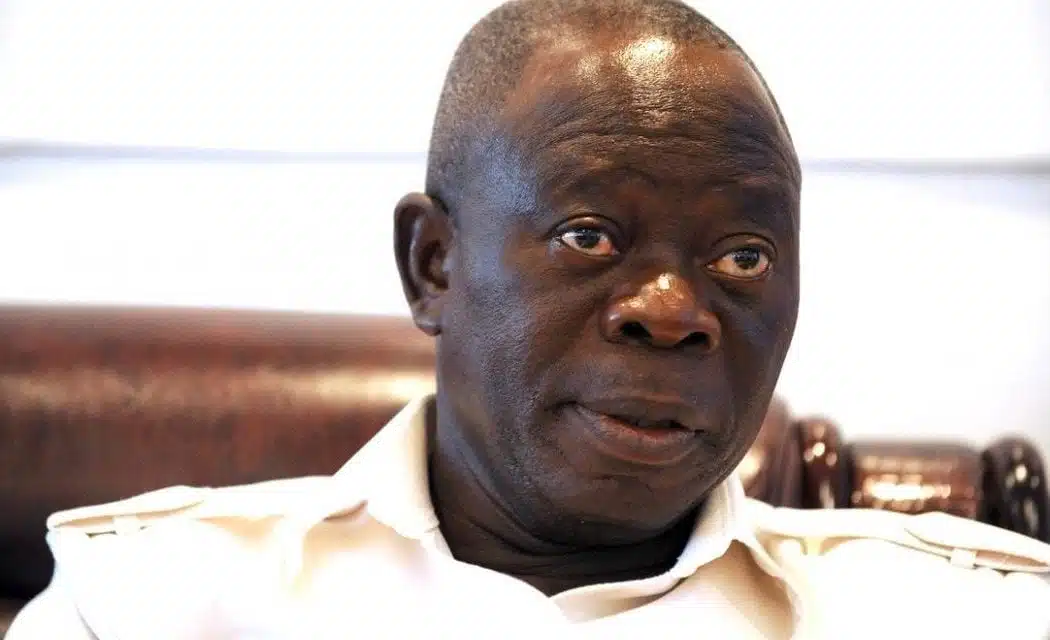
In the high-stakes theater of Nigerian politics, where the “godfather” system and financial patronage often dictate the rhythm of the polls, Senator Adams Oshiomhole has thrown a provocative challenge to the status quo. The former Governor of Edo State recently took a trip down memory lane, asserting that his landmark 2012 re-election victory was achieved through the currency of performance rather than the distribution of cash. Speaking on a national television program, the veteran labor leader turned politician insisted that he broke the traditional mold of “stomach infrastructure” to secure a second term.
Oshiomhole’s narrative centers on a rare moment of political defiance. He claims that during his 2012 campaign, he was blunt with the electorate about his refusal to participate in the pervasive culture of vote-buying. At a time when the political climate was tense and the opposition was formidable, the former governor says he drew a line in the sand. He told voters that if his opponents offered money, they should take it—viewing it perhaps as a late dividend of democracy—but they should not expect a single kobo from his own camp.
The strategy, as he describes it, was based on a simple trade-off: development for trust. Oshiomhole argued that his “all” was invested in the infrastructure and social services of Edo State, leaving no room for the illicit “handouts” that typically characterize Nigerian elections. The results of that 2012 poll were indeed historic, as he swept all 18 Local Government Areas of the state. To Oshiomhole, this clean sweep was a validation that the Nigerian voter can be swayed by tangible progress rather than temporary financial inducements.
His reflections come at a critical juncture for Nigeria as the nation begins to eye the 2027 general elections. The conversation around electoral integrity has never been more urgent. Oshiomhole’s comments serve as a critique of the current democratic landscape, where the manipulation of results and the auctioning of votes threaten to hollow out the meaning of the ballot box. He maintains that the “beauty of democracy” lies in the sacred trust placed in an individual to manage the resources of millions.
Addressing the technicalities of the law, the Senator pointed out that Nigeria does not necessarily suffer from a lack of regulations. Instead, it suffers from a deficit of enforcement. He noted that the country’s electoral laws are already equipped with stringent sanctions designed to deter malpractice. These laws target not just the politicians who buy votes, but also the electoral officers who might be tempted to “twist or destroy” ballot sheets to favor a loser.
Oshiomhole emphasized that the penalties for undermining the will of the people are severe. According to him, the legal framework provides for both heavy fines and actual jail time for those caught subverting the democratic process. His argument is that if these existing laws were applied with total impartiality, the incentive for electoral fraud would evaporate. For him, cheating in an election is not just a political offense; it is the “worst crime” one can commit against a sovereign people.
The Senator’s stance highlights a growing frustration within the political class and the citizenry regarding the slow pace of electoral reforms. While technology like the Bimodal Voter Accreditation System (BVAS) has been introduced to curb rigging, the human element of vote-buying remains a stubborn obstacle. Oshiomhole’s anecdote from 2012 is a call to return to “issue-based” campaigning, where a candidate’s track record serves as their primary campaign fund.
By revisiting his 2012 victory, Oshiomhole is essentially pitching a model for future aspirants. He suggests that when a leader delivers the “greatest good to the greatest number,” the need for financial coercion disappears. It is a romantic view of politics that often clashes with the harsh realities of the field, but Oshiomhole insists it is the only way to preserve the integrity of the state.
As the debate over the 2027 roadmap intensifies, the former governor’s words will likely spark a conversation about the feasibility of “cashless” campaigning in modern Nigeria. Can a candidate truly win in the current economic climate without “oiling the wheels”? Oshiomhole believes his past is proof that it is possible. Whether the current crop of politicians has the courage to test that theory remains to be seen, but the Senator’s message is clear: democracy is only as valuable as the honesty of the process that produces it.

