
Politics
Ganduje Signals Possible Peace Deal With Kwankwaso
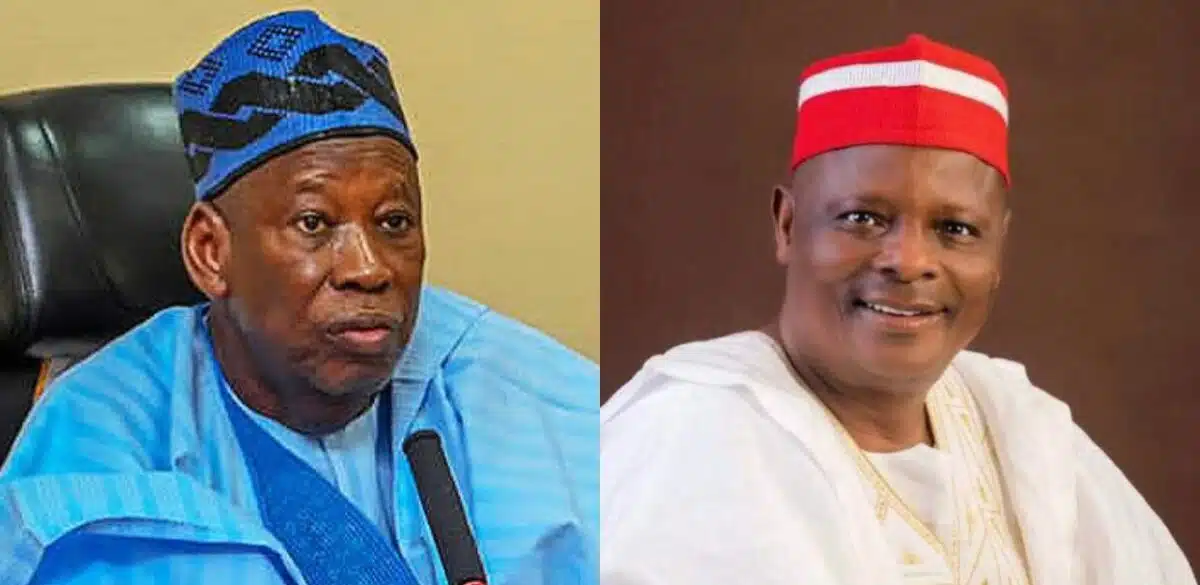
The political atmosphere in Northern Nigeria is witnessing a dramatic shift as the National Chairman of the All Progressives Congress (APC), Dr. Abdullahi Ganduje, has publicly signaled an opening for reconciliation with his long-time rival, Senator Rabiu Musa Kwankwaso. This unexpected olive branch follows years of intense political friction between the two titans of Kano politics, whose fractured relationship has historically divided the state’s electorate.
Speaking in a recent interview with the BBC, Ganduje grounded his move toward peace in his religious convictions. He noted that as a Muslim, permanent enmity is discouraged, suggesting that political disagreements should never be viewed as terminal. He emphasized that despite their recent clashes, the shared history between him and the New Nigeria Peoples Party (NNPP) leader remains a foundation upon which a new understanding could be built.
The timing of this statement is particularly significant. It comes on the heels of the high-profile defection of the Kano State Governor, Abba Kabir Yusuf, from the NNPP to the APC. This move has effectively rewritten the political script in the North, placing Ganduje and his former protégé turned successor in the same camp. Ganduje expressed immense satisfaction with this development, describing the Governor’s entry into the APC as a victory for the party and the people of Kano.
Reflecting on his decades-long journey with Kwankwaso, Ganduje described the Senator as a “brother” and a veteran of the same political trenches. He noted that while the path of leadership often leads to temporary friction, the ultimate goal of governance should always be the collective progress of the state. He suggested that the time has come to bury the hatchet and focus on the development of Kano under a unified front.
The APC Chairman was quick to point out that the success of the current administration in Kano is now inextricably linked to the success of the APC. He argued that if the Governor succeeds in his mandate, the party shares in that glory, and conversely, any failure would be felt by all stakeholders. This “all for one” approach marks a departure from the antagonistic rhetoric that defined the state’s political discourse over the last several years.
Addressing the internal mechanics of the APC, Ganduje highlighted that leadership positions are never permanent fixtures. He revealed that the party is preparing for internal elections starting at the ward level and culminating in the national level by the end of February. This democratic process, he noted, will determine the new hierarchy and ensure that all incoming members, including the Governor’s faction, find their place within the party’s structure.
One of the more contentious issues surrounding the recent realignment has been the rumor of a power-sharing formula. Speculation had been rife regarding a “60-40” split of party executive positions, allegedly designed to favor Governor Yusuf’s camp. However, Ganduje was firm in dismissing these claims as unofficial. He clarified that the national leadership of the APC has not issued any written directive or formal recognition of such an arrangement.
Instead, Ganduje emphasized that the primary motivation for the Governor’s move should be viewed as a commitment to the welfare of the poor and the general progress of the state. He stressed that while certain privileges might have been altered during the transition from the NNPP to the APC, the focus remains on building a government that works for the masses rather than focusing on shared percentages of power.
The prospect of a Ganduje-Kwankwaso reconciliation has sent ripples through the Nigerian political community. For years, the “Red Cap” movement of Kwankwaso and the Ganduje-led APC faction have engaged in a proxy war that influenced everything from local government policies to the traditional institution of the Emirate. A truce between these two figures could potentially create an unprecedented political monolith in Kano State.
Observers are now watching to see how Kwankwaso, the national leader of the NNPP, will respond to this public overture. While the Senator has remained relatively quiet regarding the recent defections, the pressure to maintain his political influence in the North may dictate his next move. Ganduje’s comments suggest that the door is not just ajar but wide open for a return to the status quo of their earlier partnership.
As the 2027 election cycle begins to take shape, this potential realignment could redefine the APC’s strength in the North-West. By consolidating the various political factions under one umbrella, Ganduje appears to be aiming for a stabilized and dominant presence in Nigeria’s most populous voting bloc. The coming weeks will reveal whether this is a genuine move toward peace or a strategic masterstroke to further isolate political opposition.
For the average citizen in Kano, the prospect of an end to the “feud of the giants” brings hope for a more stable governance environment. With the Governor now in the same party as the APC National Chairman, the administrative friction that often accompanies divided loyalty is expected to wane. Ganduje’s vision of a unified Kano suggests that the era of bitter rivalry may finally be giving way to a season of pragmatic collaboration.


