
NEWS
Inside the Saraki-Jonathan Feud: How Yar’Adua’s Shadow Split the PDP
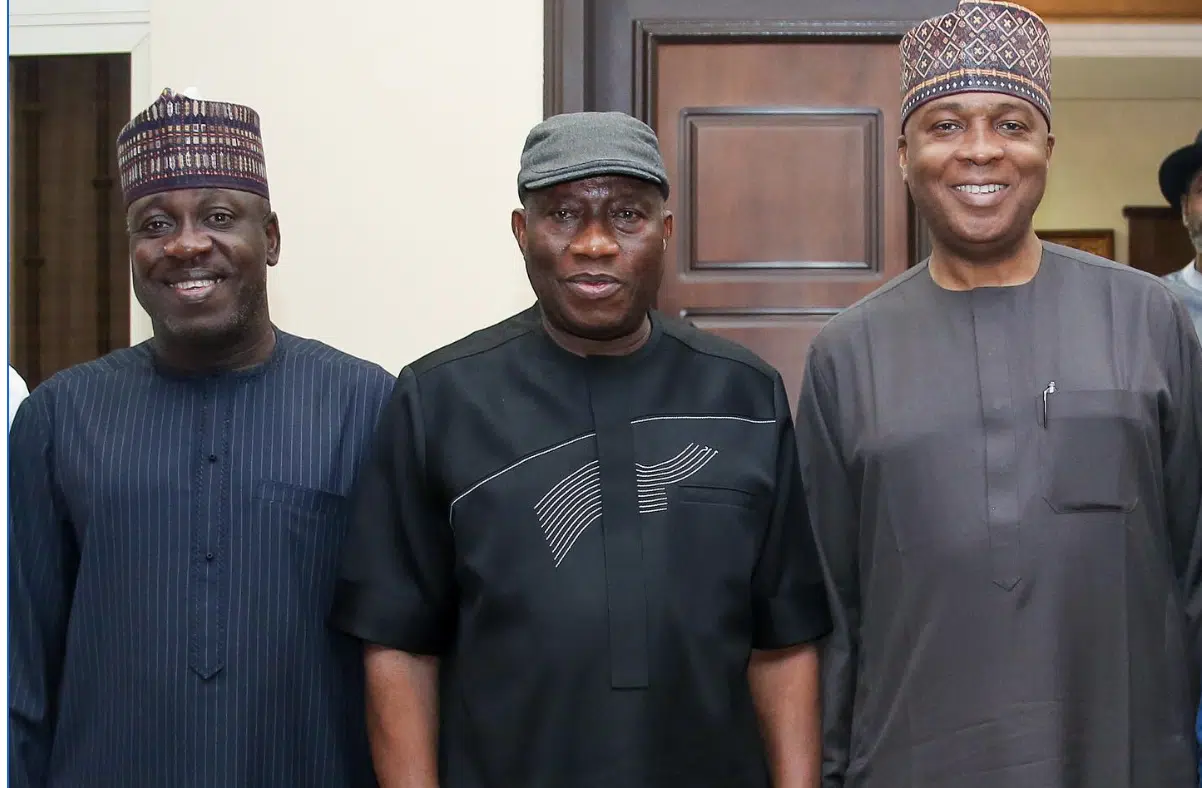
The intricate and often turbulent history of Nigeria’s political elite took center stage in Abuja this week as Bolaji Abdullahi, the National Publicity Secretary of the African Democratic Congress (ADC), pulled back the curtain on one of the most consequential rivalries in the Fourth Republic. At the public presentation of his memoir, The Loyalist, Abdullahi traced the deep-seated friction between former Senate President Bukola Saraki and former President Goodluck Jonathan back to the quiet corridors of the late Umaru Musa Yar’Adua’s presidency.
Abdullahi, who famously served as a minister under Jonathan before being ousted for his refusal to campaign against Saraki in Kwara State, offers a rare insider’s perspective on the psychological and political origins of the rift. According to the author, the seeds of discord were sown not during the 2015 elections, but years earlier, rooted in the perceived hierarchy and access levels within the Yar’Adua administration.
In the book’s ninth chapter, Abdullahi paints a vivid picture of a Vice President who often felt sidelined. At the time, Bukola Saraki, as the Chairman of the Nigeria Governors’ Forum (NGF), enjoyed a level of intimacy with President Yar’Adua that Jonathan seemingly did not. Abdullahi suggests that the proximity between Yar’Adua and the “powerful governors” led to a lingering resentment, with Jonathan feeling that this inner circle viewed him merely as an accidental “deputy governor” despite his status as the nation’s number two citizen.
Even as Yar’Adua attempted to bridge this gap by asking Saraki to “smooth things over” with Jonathan, the efforts resulted in nothing more than polite civility. The genuine trust required for a stable political partnership was never established. This lack of candor became a ticking time bomb when Yar’Adua fell terminally ill in a Saudi Arabian hospital, sparking a constitutional crisis that would eventually redefine Nigerian politics.
When the struggle for the “Acting Presidency” began, many in Jonathan’s camp became convinced that Saraki was working to block his path to power. The narrative at the time was that the Kwara strongman was protecting Yar’Adua’s seat to preserve Northern interests. However, Abdullahi uses his memoir to debunk this long-held perception. He reveals that it was actually Saraki who initiated the “Doctrine of Necessity,” the legal masterstroke that allowed the National Assembly to empower Jonathan while avoiding a vacuum of leadership.
Despite this pivotal support, the ghosts of the past continued to haunt their relationship. Once Jonathan was firmly in the saddle, the suspicion remained that Saraki’s loyalty was conditional. This was exacerbated by the 2011 PDP primaries, where Saraki was involved in a Northern consensus arrangement aimed at producing a challenger to Jonathan. Even after Saraki eventually threw his weight behind the President, the “loyalty test” had already been failed in the eyes of the Presidency.
The relationship hit a point of no return during the fuel subsidy crisis of 2012. Abdullahi identifies Saraki’s October 2011 Senate motion—which called for a probe into subsidy payments—as the spark that ignited the Occupy Nigeria protests. The Jonathan administration viewed the motion not as a quest for transparency, but as a deliberate political landmine designed to destabilize the government. This event, Abdullahi argues, was the beginning of the end for the Jonathan presidency, creating a wound that never truly healed before the 2015 polls.
The memoir also touches on the weaponization of state institutions, describing a tense encounter where Saraki directly confronted Jonathan over the Economic and Financial Crimes Commission (EFCC) probes into his family. While Jonathan denied personal involvement, the damage to their political synergy was irreparable. This narrative serves as a cautionary tale of how personal perceptions and administrative siloes can bring down even the most powerful political machines.
As the 2026 political cycle draws closer, Abdullahi’s reflections offer a sobering look at the fragility of alliances in the Nigerian power structure. The Loyalist does more than just recount history; it provides a roadmap of the egos and errors that shifted the course of a nation. For political observers, the book is a vital piece of the puzzle in understanding why the PDP, once a “behemoth,” eventually fractured under the weight of its own internal suspicions.
The public presentation attended by political heavyweights and scholars alike has reignited conversations about the necessity of trust in governance. Abdullahi’s account reminds us that in the world of high-stakes politics, sometimes the most significant battles are not fought on the campaign trail, but in the quiet rooms where a Vice President feels ignored and a Governor feels misunderstood.


