
Politics
Justice on the Edge: Ememobong Warns Judiciary Against Political Drift
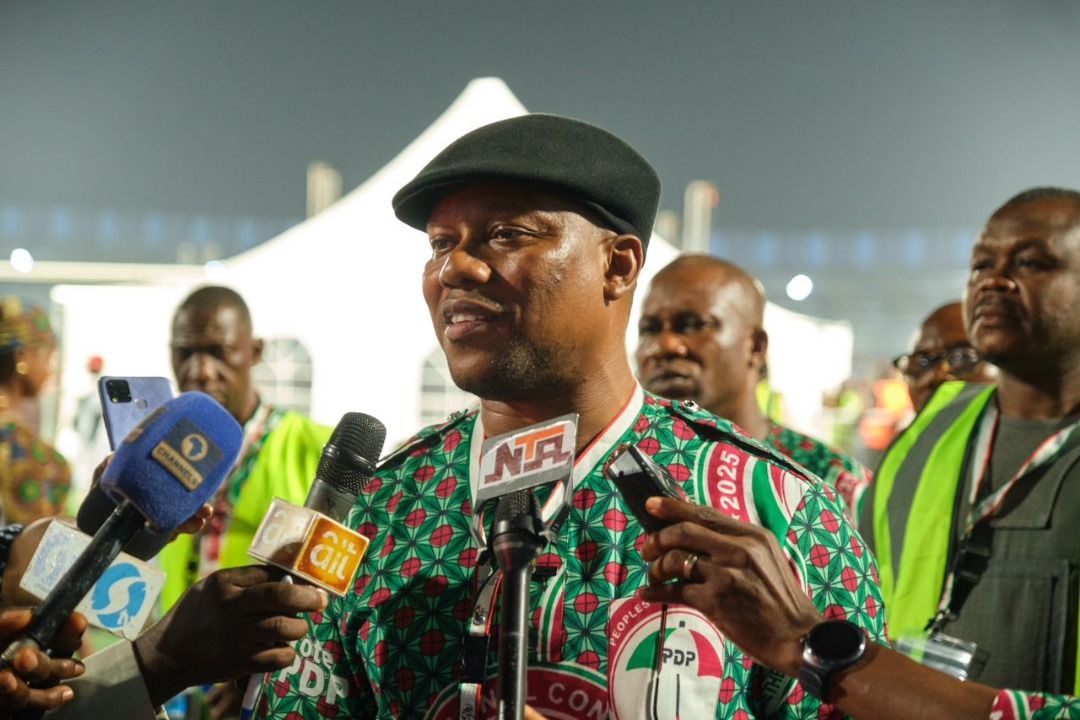
The delicate balance between the bar and the political bench is facing a new wave of scrutiny as Ini Ememobong, the National Publicity Secretary of the Peoples Democratic Party (PDP), issues a sharp warning to the Nigerian judiciary. In a compelling appearance on Arise Television’s “Prime Time,” the party spokesman argued that the courts are increasingly overstepping their bounds, venturing into the internal thickets of political parties where they risk losing their impartial robes to the dust of partisan politics.
At the heart of Ememobong’s critique is a recent Federal High Court judgment that nullified the PDP’s national convention held in Ibadan. The ruling, which has sent shockwaves through the party’s leadership structure, effectively restrained the Tanimu Turaki-led National Working Committee (NWC) from acting on behalf of the party. For Ememobong, the decision is not just a legal setback but a symptom of a deeper “perception crisis” currently plaguing the third arm of government.
The PDP spokesman was particularly vocal about what he described as a troubling “convergence of perception and reality.” He pointed to public interactions between high-ranking judicial officers and political figures as a source of public skepticism. Specifically, he referenced a courtesy call where judicial leadership allegedly engaged the Minister of the Federal Capital Territory (FCT), Nyesom Wike, regarding land and housing for judges. While not making a direct accusation of impropriety, Ememobong stressed that when such optics exist, the public’s faith in the neutrality of subsequent judgments is inevitably eroded.
“Justice must not just be done, but it must be seen to be done,” Ememobong remarked, echoing a fundamental legal maxim. He argued that the judiciary must remain an island of neutrality, especially when dealing with the internal friction of political organizations. In his view, the court’s intervention in the Ibadan convention lacked a constitutional basis within the party’s own framework, suggesting that “my lord” would struggle to find the concept of a “national caretaker” in the PDP’s governing documents.
The ruling in question has essentially created a leadership vacuum that the PDP is now scrambling to fill through the appellate process. By nullifying the convention and recognizing a different leadership faction, the court has effectively placed itself in the driver’s seat of the party’s future. Ememobong warns that this level of involvement is a slippery slope, where judges could eventually be viewed more as political arbiters than as dispensers of law.
Despite the heavy criticism, Ememobong maintained a tone of “tremendous respect” for the institution of the court, framing his remarks as a necessary intervention to protect the judiciary from itself. He believes that for democracy to thrive, parties must be allowed the space to resolve their own internal conflicts without constant judicial oversight, provided those processes don’t violate the fundamental rights of members.
The fallout from the Ibadan convention nullification is the latest chapter in a long-running saga of litigation within the PDP. From the era of Ali Modu Sheriff to the more recent battles involving Iyorchia Ayu, the party has often found its fate decided in courtrooms rather than at convention grounds. Ememobong’s plea is a call for a return to a time when political parties functioned as autonomous “universities of democracy,” capable of self-correction without the gavel’s intervention.
As the PDP prepares to take its case to the Court of Appeal, the spotlight remains fixed on the Federal High Court. The party’s legal team is expected to argue that the lower court’s decision was an overreach that ignored the principle of non-interference in domestic party affairs. For now, the “Turaki-led” NWC remains in a state of legal limbo, awaiting a higher court’s word to either validate their mandate or confirm their exit.
Ememobong’s message serves as a broader commentary on the health of Nigerian democracy. When the judiciary becomes a regular participant in the internal mechanics of political parties, it risks becoming a lightning rod for political frustration. By urging the courts to “stay away,” the PDP spokesman is betting that a more hands-off approach will actually strengthen the judiciary’s long-term credibility.
The coming months will determine whether the courts heed this warning or continue to play a decisive role in the realignment of Nigeria’s opposition ahead of 2027. If the perception of political influence in the judiciary continues to grow, as Ememobong suggests, the very foundation of the legal process may be at stake.