
Politics
Northern Group Backs Southern Power Shift
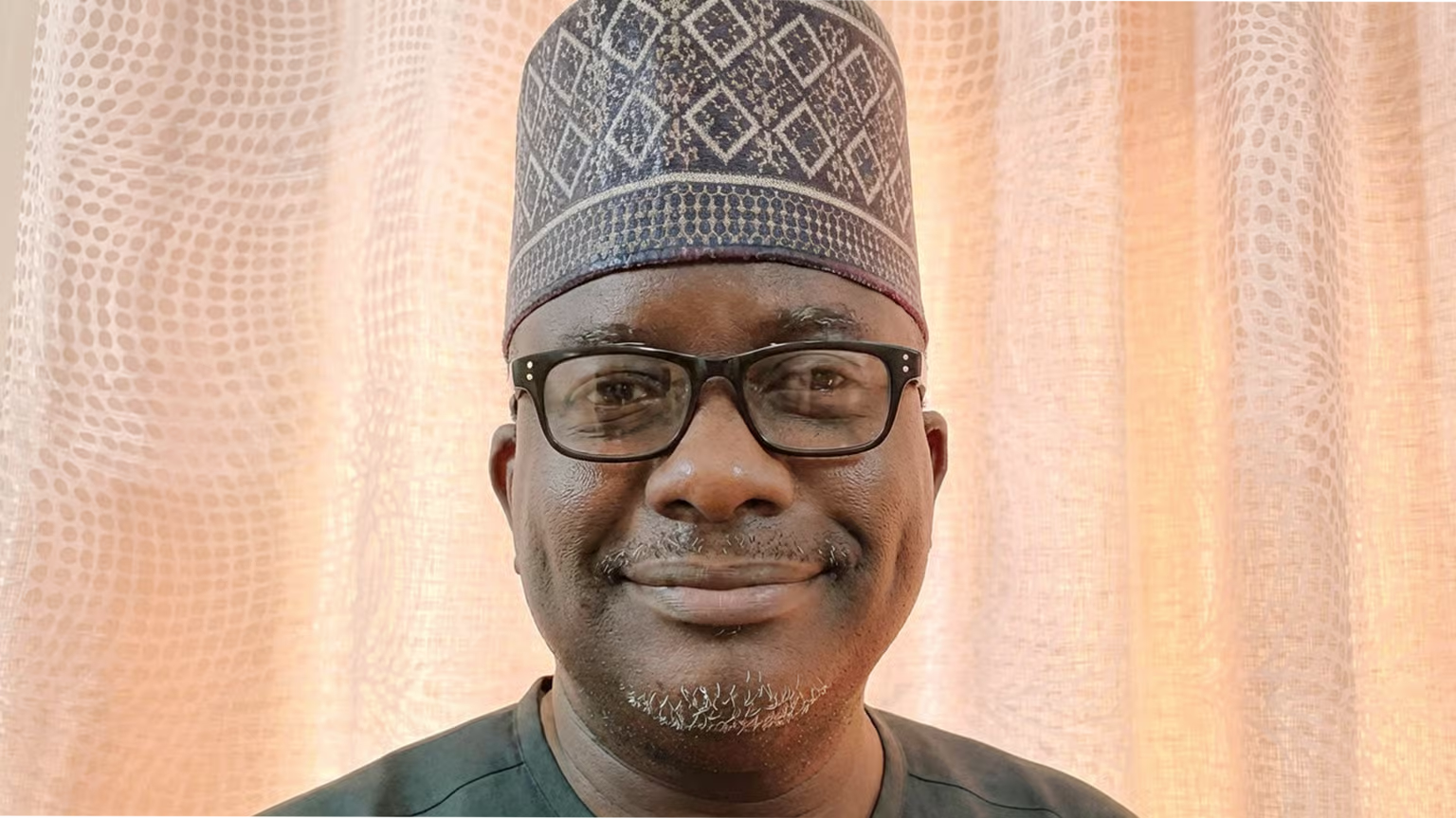
In a major political shift ahead of the 2027 general elections, Umar Tanko-Yakasai, the Director-General of the Tinubu Support Group (TSG), has called on Northern political heavyweights to respect the principle of power rotation. Speaking in Abuja on Monday, January 26, 2026, Tanko-Yakasai specifically addressed former Vice President Atiku Abubakar and ex-Kaduna State Governor Nasir El-Rufai, urging them to prioritize national stability and equity over regional ambitions.
The call for a Southern-led presidency to complete a full eight-year term was bolstered by a massive show of financial support from the Northern Nigeria Youth Leaders Forum (NNYLF). The group presented Tanko-Yakasai with a symbolic ₦200 million cheque, intended for the purchase of President Bola Tinubu’s nomination and expression of interest forms. This early mobilization suggests that the machinery for the President’s re-election is already active, nearly a year and a half before the next polls.
Tanko-Yakasai argued that the North must remain true to its word by upholding the unwritten agreement that power should reside in the South for two consecutive terms. He emphasized that any attempt by Northern politicians to reclaim the presidency in 2027 would be viewed as an act of “selfish interest” that undermines national unity. “For us in northern Nigeria, we are men of our words,” he declared, framing the support for Tinubu as a moral and political obligation.
While some factions are rallying behind the current administration, the political atmosphere in the North remains fractured. High-profile figures like El-Rufai have expressed skepticism about the ruling party’s long-term viability, suggesting a potential shift in the region’s support. However, by accepting the ₦200 million pledge, Tanko-Yakasai is signaling that a substantial portion of the Northern grassroots remains committed to the Tinubu project, despite critiques from regional elites.
Parallel to these developments, the Obidient Movement has released a stern rebuttal against what it calls “divisive labeling.” National Coordinator Yunusa Tanko issued a statement on Monday defending the movement’s reputation against accusations of extremism. Tanko insisted that the surge of support for Peter Obi was not born out of intolerance, but was a legitimate reaction to years of institutional decay, systemic poverty, and a political structure that had disenfranchised ordinary Nigerians.
The Obidient Movement has recently pivoted toward a coalition with the African Democratic Congress (ADC), a move that has sparked debate about its core identity. Yunusa Tanko clarified that while the movement is engaging with the ADC, its loyalty remains rooted in the principles of good governance and reform. He dismissed claims that the movement is a threat to national unity, arguing instead that vocal political engagement is a healthy sign of a maturing democracy and should not be confused with hostility.
The movement’s statement also addressed friction within the ADC coalition. Following Peter Obi’s strategic alignment with the party in December 2025, internal factions have reportedly struggled with the influx of “Obidient” loyalists. Tanko maintained that coalitions are platforms for collaboration rather than enforced silence. He asserted that the movement would continue to challenge any political structure that does not align with its reformist agenda, even within its newly chosen alliances.
As the political chess pieces for 2027 begin to move, the narratives are becoming increasingly clear. One camp is banking on the “fairness” of a Southern eight-year cycle, backed by significant financial war chests from Northern youth groups. The other camp, represented by the Obidient-ADC alliance, is positioning itself as the voice of the frustrated masses, refusing to be silenced by traditional political labels or regional zoning debates.
For Northern leaders like Atiku and El-Rufai, the challenge remains navigating a region that is no longer a monolithic voting bloc. The ₦200 million gesture from the NNYLF serves as a reminder that the “spirit of fairness” cited by Tanko-Yakasai carries significant weight—and significant funding—at the grassroots level. Meanwhile, the Obidient Movement’s refusal to accept a “divisive” tag suggests that the next election cycle will be as much about identity and reputation as it is about policy and power.