
NEWS
Olubadan Backs Tinubu on Security and Economy
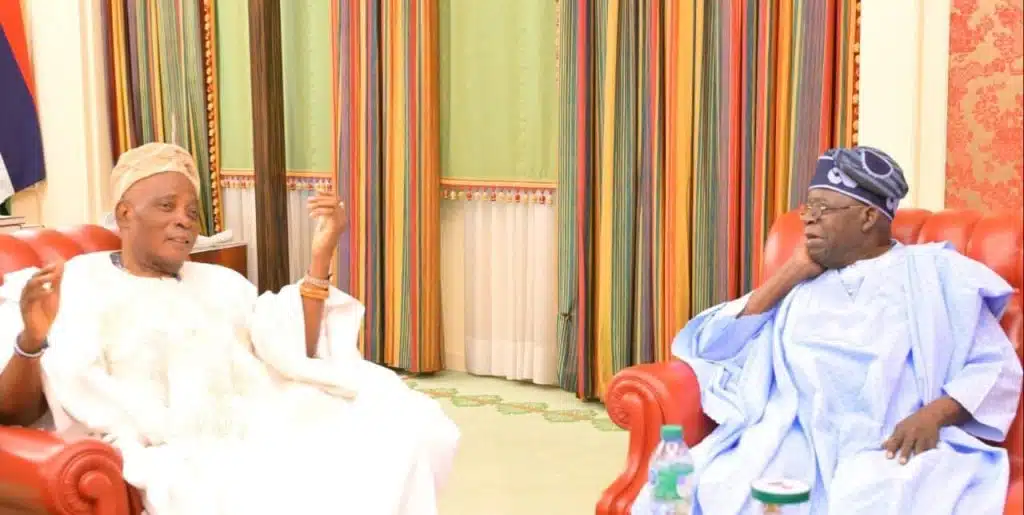
The Olubadan of Ibadanland, Oba Rashidi Adewolu Ladoja, has expressed strong confidence in President Bola Tinubu’s capacity to navigate Nigeria through its current security and economic headwinds. Speaking on Friday, January 23, 2026, following a high-profile, closed-door meeting at the Presidential Villa in Abuja, the monarch described the nation’s challenges as difficult but entirely surmountable under the current leadership.
Oba Ladoja, who ascended the throne as the 44th Olubadan in September 2025, used his first official visit to Aso Rock to thank the President for his personal support during his coronation. The visit provided a moment of reflection for the monarch, a former Governor of Oyo State, who noted that his presence in the capital for the Daily Trust Dialogue offered the perfect opportunity to convey the appreciation of the Ibadan people to the Commander-in-Chief.
Addressing State House correspondents, the Olubadan identified insecurity as the most pressing hurdle facing the federation. He highlighted the growing apprehension among rural dwellers and farmers, particularly as the threat of banditry and kidnapping begins to encroach more noticeably on the southern regions. “Farmers find it difficult to go to their farms,” the monarch lamented, emphasizing that this fear disrupts the very foundation of the nation’s food security and daily economic life.
Despite these concerns, the Olubadan maintained an optimistic outlook, asserting that the President is currently “tackling it correctly.” He urged Nigerians to look at Tinubu’s historical performance in Lagos State as a blueprint for what is possible on a national scale. “If you know where he is coming from, you will know that he knows what he is doing,” the monarch said, pointing to the transformation of Lagos during Tinubu’s tenure as governor as evidence of his ability to reform complex systems.
Oba Ladoja acknowledged that governing Nigeria is a vastly more intricate task than managing a single state, given the diverse notions and expectations of over 200 million citizens. However, he observed that the federation is in a better financial position now than during his own time as a governor in the early 2000s. According to the monarch, states now have access to more resources, allowing them to better meet their developmental commitments to the people.
The economy remained a central theme of the monarch’s remarks. He noted that while the reforms have been painful, the nation’s economic “corner” has been turned. He predicted that by the time President Tinubu completes his expected second term in 2031, he will have laid a foundation for a Nigeria that all citizens can be proud of. This long-term vision, the Olubadan suggested, is the hallmark of a leader focused on legacy rather than short-term political gains.
Beyond security and the economy, the Olubadan’s visit to Abuja also touched on regional concerns. Only a day prior, the monarch had held discussions with the Secretary to the Government of the Federation, George Akume, regarding ecological issues threatening parts of Ibadan. These series of high-level meetings suggest a monarch who is deeply engaged in leveraging his traditional office to advocate for infrastructure and environmental stability for his domain.
The Olubadan’s endorsement is seen by many political analysts as a significant boost for the administration as it prepares for the mid-term evaluations of 2026. As a traditional ruler with a background in partisan politics and executive governance, Ladoja’s perspective carries weight among both the political elite and the grassroots. His call for patience and “mutual courtesy” reflects a desire for national stability during a period of intense structural adjustment.
As the monarch prepares to return to the ancient city of Ibadan, his message remains one of resilience. He challenged the government to continue prioritizing healthcare and food security, ensuring that the “bright light at the end of the tunnel” promised by the President becomes a reality for every Nigerian household before the 2031 transition.


