
Politics
Power Play: The Heated Debate Over Tinubu’s Rivers Intervention
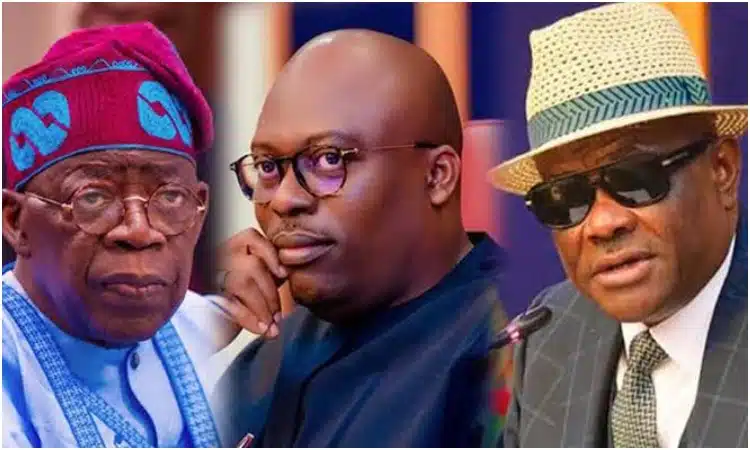
The political landscape of Rivers State remains a volatile theater of conflicting loyalties as prominent South-South stakeholders clash over President Bola Tinubu’s latest attempt to broker peace. The President’s move to halt the impeachment proceedings against Governor Siminalayi Fubara has peeled back the layers of a deep-seated power struggle, revealing a sharp divide between those who prioritize political stability and those who demand constitutional purity.
At the heart of the storm is the friction between the sitting Governor and his predecessor, the current Minister of the Federal Capital Territory, Nyesom Wike. The President’s intervention, designed to cool the heels of a pro-Wike legislative faction, has been interpreted by some as a necessary rescue mission and by others as a heavy-handed intrusion into sub-national affairs.
Joseph Ambakaderimo, a leading voice in the South-South Reawakening Group, has emerged as a staunch defender of the President’s tactical maneuvering. To Ambakaderimo, Tinubu is a “smart politician” whose primary objective is to maintain a functioning administrative environment in a state that serves as the nation’s oil hub. He views the President’s protection of Fubara not just as an act of mercy, but as a strategic calculation to keep the state from spiraling into lawlessness.
However, Ambakaderimo’s support comes with a heavy dose of realpolitik. He warns that the President must tread carefully to avoid alienating Wike, whom he describes as a vital asset to the ruling All Progressives Congress (APC). Drawing a vivid historical parallel, he likened Wike’s role to that of the late Tony Anenih during the Obasanjo era—an indispensable “enforcer” whose ability to deliver massive electoral numbers makes him a cornerstone of the central government’s regional influence.
In Ambakaderimo’s estimation, Governor Fubara simply lacks the political gravity to match Wike’s influence. He suggests that the President’s current stance is for the “overall good” of the state, even if it leaves the Governor in a somewhat diminished position. For him, the friction is a private feud between a mentor and a mentee that can only be truly resolved in their own quarters, rather than through public decrees or constitutional debates.
This pragmatic acceptance of the status quo met with a fierce rebuttal from Dr. Jackson Omenazu, Chancellor of the International Society for Social Justice and Human Rights. Omenazu’s critique was biting, characterizing the President’s intervention as lacking the “finesse” and dignity expected of the highest office in the land. He argues that by refusing to allow Fubara to function as the undisputed political leader of his own state, the President is undermining the very essence of the APC’s own internal structure.
“Why can’t Fubara be the political leader of Rivers State?” Omenazu asked, pointing out that in almost every other state controlled by the ruling party, the sitting Governor is the de facto head of the political hierarchy. He described the Governor as being “highly subjugated,” living under a shadow of authority cast from Abuja rather than ruling with the autonomy granted to him by the electorate.
Omenazu’s argument shifts the focus from political expediency to historical precedent and fairness. He reminded the public that both President Tinubu and Minister Wike once occupied governorship seats. He challenged them to recall if they would have tolerated a situation where an external force dictated their local standing or held a sword of impeachment over their heads from a distance. To him, the current treatment of Fubara is an anomaly that stains the President’s democratic credentials.
Beyond the optics, Omenazu raised a critical procedural point regarding party governance. He asserted that the President possesses no constitutional mandate to designate a state’s political leader—a role he claims is strictly within the purview of the national chairman of the APC. By bypassing these formal channels, Omenazu argues, the Presidency is creating a hybrid system of governance that favors personality over process.
The discord between these two figures reflects a broader anxiety within the Niger Delta. On one side is the fear that a weakened Wike would leave the APC vulnerable in the South-South; on the other is the fear that a weakened Fubara sets a dangerous precedent where a governor is merely a placeholder for a powerful predecessor.
As the political tug-of-war continues, Rivers State remains a litmus test for the Tinubu administration’s ability to manage its most powerful allies without disenfranchising its elected officials. The “peace” currently holding in Port Harcourt is widely viewed as a fragile truce, one that relies more on the President’s personal influence than on a genuine resolution of the underlying grievances.
The debate serves as a stark reminder that in the complex world of Nigerian politics, the lines between peacekeeping and power-sharing are often blurred. While Ambakaderimo believes the President is doing what is necessary for survival, Omenazu insists that the long-term health of Nigerian democracy requires a leader who is “presidential enough” to uphold the dignity of the office of the Governor.


