
Politics
Umahi Claims Tinubu Ends Biafra Agitations
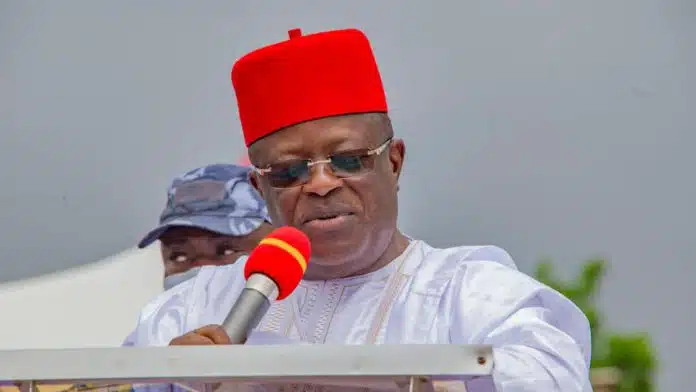
The political landscape of the Southeast shifted on Tuesday, January 27, 2026, as the Minister of Works, David Umahi, declared that the era of secessionist agitation has been effectively neutralized by the inclusive policies of President Bola Tinubu. Speaking at his country residence in Umunaga Uburu, Ebonyi State, Umahi asserted that the All Progressives Congress (APC) is now the only viable vehicle for the region’s development and political survival.
Addressing a large gathering of supporters following the primary victory of his son, Osborne Nweze Umahi, as the APC chairmanship candidate for Ohaozara Local Government Area, the Minister argued that the grievances which once fueled the Biafra movement have been addressed. He emphasized that the agitation was a direct consequence of decades of systemic neglect, a narrative he claims is now being rewritten through massive federal infrastructure investment and strategic political appointments.
Umahi was unequivocal in his praise for the current administration, stating that President Tinubu has “defied all the agitation” from the region by integrating its leaders into the core of national governance. He urged the youths of the Southeast to abandon “sentiments” and emotional rhetoric in favor of strategic political participation. According to the Minister, the region’s future is tied to its ability to align with the center rather than remaining in what he described as political isolation.
The call for a massive membership drive across the five Southeast states was a central theme of his address. Umahi insisted that there is “no alternative” to the APC for any Igbo person seeking national relevance or sustainable growth. He pushed for a “social re-engineering” of the minds of those still clinging to separatist narratives, suggesting that the “true Biafra”—defined by economic empowerment and infrastructure—is already being built by the current government.
In a move to consolidate power locally, Umahi used the occasion to celebrate his son’s emergence as a chairmanship candidate, describing it as a win for the youth and a testament to the party’s internal democracy. He aligned himself with Osborne’s proposed agenda of opening rural roads and creating agricultural clusters, framing it as a grassroots extension of President Tinubu’s national renewal plan.
Defending the federal government’s controversial road projects, the Minister dismissed criticisms regarding road conditions as “political blackmail.” He argued that the transition to concrete road technology is a transformational shift that will ensure highways last for fifty to one hundred years. For Umahi, these tangible projects serve as a more powerful response to marginalization than any protest or sit-at-home order could provide.
The Minister also touched on the sensitive issue of the presidency, advising the Southeast to remain patient and united. He maintained that while the region deserves a credible shot at the highest office, such an achievement cannot be reached through “venomous statements” or intimidation. Instead, he proposed that a credible candidate will emerge at “God’s own time,” facilitated by the region’s loyalty to the ruling party.
Critics and opposition figures in the region have previously labeled Umahi’s integrationist stance as a betrayal of Igbo sensibilities, but the Minister remained undeterred. He concluded by framing 2026 as a “year of restoration” for Nigeria, urging Ndigbo to be equal partakers in the nation’s progress. As the 2027 general election cycle begins to loom, Umahi’s message is clear: the Southeast must choose the ballot over the barricade.


