
Politics
Utomi: Nigeria’s Greatness May Arrive After My Time
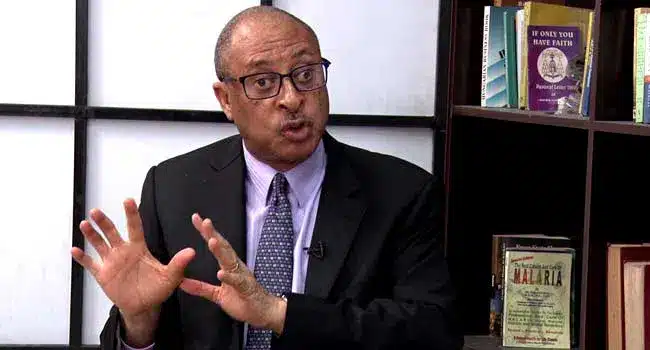
In a poignant reflection on the state of the Nigerian republic, renowned political economist and former presidential candidate Pat Utomi has suggested that the nation’s true potential might only be realized long after his generation has passed. Speaking with a blend of intellectual weariness and enduring hope during an appearance on Arise Television, Utomi lamented that Nigeria has systematically turned its back on “intellectual leadership,” favoring the acquisition of raw power over the cultivation of transformative ideas.
Utomi’s analysis traces the root of the current national malaise back to the critical 1999 transition from military to civilian rule. He argued that the departure of the military did not necessarily mean the departure of militarized thinking. Instead, the focus on ideas that once characterized the nation’s founding fathers was replaced by a hollowed-out version of democracy where power serves itself. This “abandonment of ideas,” he warned, has effectively poisoned the public sphere and left the country’s democratic institutions without a solid philosophical foundation.
During the interview, Utomi shared a deeply personal anecdote regarding his own sense of legacy. He recalled a conversation with Reverend Father George Ehusani, who drew a striking parallel between Utomi’s struggles and the life of Socrates. The ancient Greek philosopher was forced to drink poison for his beliefs, yet the foundations of Western civilization were eventually built upon his thoughts. Utomi admitted that he finds a bittersweet consolation in the possibility that Nigeria’s eventual greatness may be built upon the ideas he has championed, even if he does not live to see their fruition.
Despite the sober comparison, the professor insisted that he still harbors hope for progress within his lifetime. He framed Nigeria’s survival not just as a political necessity, but as a unique historical mission. Utomi posits that the country was “gifted to humanity” to redeem the dignity of the Black man, which has been trampled by centuries of colonial oppression and slavery. He urged the current generation to view themselves as a “redeeming generation,” tasked with reversing the “road to serfdom” and positioning Nigeria as the trigger for a wider continental awakening.
To illustrate the decline in intellectual discourse, Utomi pointed to the giants of Nigeria’s past. He noted that figures like Obafemi Awolowo were profound philosophers even in their youth, and that the legendary Fela Anikulapo Kuti remains one of the greatest philosophers of all time. The rupture, according to Utomi, occurred when the sudden influx of oil wealth combined with prolonged military rule, leading a once-thoughtful political class to trade their vision for SUVs and bloated motorcades.
Utomi’s critique was particularly sharp regarding the current political culture, which he believes has become dangerously unmoored from the common good. He warned that power without the guidance of ideas leads to lasting harm, creating a cycle where each administration simply repeats the mistakes of the one before it. The loss of “strategic relevance” in the world, he noted, is the direct result of having a leadership class that is no longer able to engage in rational, long-term analysis of how societies thrive or fail.
Addressing the youth and future leaders, Utomi stressed that each generation must define and pursue its own mission. While he feels he has contributed across two generations of struggle, he believes the mantle has now passed to a new group of Nigerians who must decide whether to continue down the path of materialism or return to the path of integrity and merit. He maintained that the “hungry country” cannot continue to spend its limited resources on the egos of politicians while its roads decay and its people suffer.
Ultimately, Pat Utomi’s message was one of historical patience. While he continues to advocate for systemic changes—ranging from constitutional reforms to a drastic reduction in the cost of governance—he is increasingly reconciled with the role of a philosophical architect. If Nigeria does eventually find its way toward the redemption he envisions, he believes it will be because the nation finally returned to the “intellectual leadership” it discarded decades ago.