
NEWS
Legal Firestorm Erupts as Maxwell Opara Slams Soludo Over Onitsha Market Closure
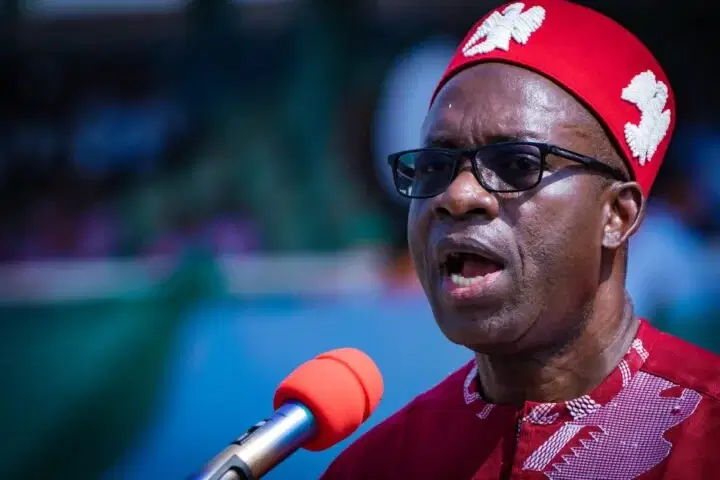
The commercial heartbeat of Southeast Nigeria is currently entangled in a constitutional tug-of-war following Governor Chukwuma Soludo’s controversial decision to seal the iconic Onitsha Main Market. Prominent human rights lawyer Maxwell Opara has stepped into the fray, delivering a stinging rebuke of the Governor’s actions, which he has officially termed as “executive recklessness” and a blatant abuse of constitutional authority.
The crisis stems from a directive issued by the Anambra State government mandating that traders disregard the long-standing Monday sit-at-home orders and resume full business activities. When traders, citing security concerns and personal choice, failed to comply, the Governor responded by locking down the facility. Opara, speaking during a high-profile interview on ARISE Television, argued that this move crosses a dangerous line into authoritarianism.
According to the legal expert, the shops and stalls within the Onitsha Main Market are private properties where individuals conduct business using their personal capital. He maintained that in a democratic setting, the state has no legal standing to dictate the hours of operation for private enterprises, especially when no laws are being broken. Opara suggested that the Governor’s intervention is fundamentally misplaced and legally indefensible.
The lawyer clarified that the government’s legitimate role in this scenario should be limited to security. He argued that if there were criminal elements physically coercing traders to stay at home, the state’s duty would be to arrest those individuals. However, if the traders choose to stay at home out of fear or solidarity, forcing them to open by sealing their premises constitutes an infringement on their basic human rights and freedom of association.
Opara went further to describe the Governor’s strategy as a relic of a military era that has no place in Nigeria’s current civil dispensation. He noted that using executive power to punish citizens for their perceived inaction is not only ethically questionable but also strategically flawed. Reports from Onitsha suggest that the move has backfired, sparking widespread protests and deepening the rift between the state government and the commercial class.
The legal practitioner pointed out that the closure has proven ineffective in restoring normalcy. Instead of reviving economic activity, the government’s heavy-handedness has paralyzed it further, as traders have shifted from passive non-compliance to active revolt. He observed that the streets of Onitsha are currently witnessing a surge in tension, with the very people the Governor intends to “liberate” from the sit-at-home order now taking to the streets in defiance.
Offering a path toward resolution, Opara emphasized that governance in a volatile region requires the “soft power” of dialogue rather than the “hard power” of lockdowns. He suggested that the Governor should have engaged in extensive consultations with market management, bank executives, and transport unions to build confidence and provide tangible security assurances before demanding a return to work.
A significant portion of the tension, according to Opara, is rooted in the continued detention of Nnamdi Kanu, the leader of the Indigenous People of Biafra (IPOB). As one of the lawyers representing Kanu, Opara provided a sobering perspective on the emotional landscape of the Southeast. He stated that a vast majority of the Igbo population holds a deep-seated respect for Kanu, and their refusal to trade on Mondays is often a symbolic gesture of that loyalty.
During the recent protests in Onitsha, demonstrators were reportedly seen chanting songs in praise of Kanu, even as they faced the closure of their shops. Opara argued that no amount of executive orders can break this emotional bond. He suggested that the most effective way for Governor Soludo and his colleagues in the Southeast Governors’ Forum to end the sit-at-home phenomenon is to engage the Federal Government directly to secure Kanu’s release.
The lawyer’s critique serves as a warning that legal actions may soon be filed against the Anambra State government. Opara hinted that affected traders have strong grounds to sue for damages resulting from the loss of livelihood and the illegal sealing of their private properties. This potential legal battle could set a major precedent regarding the limits of a Governor’s power over private commerce during periods of civil unrest.
As the standoff continues, the economic implications for Anambra State are mounting. Onitsha Main Market serves as a primary distribution hub for West Africa, and every day of closure ripples through the regional supply chain. Analysts worry that the “executive recklessness” described by Opara might drive investors away from a state that was once hailed as a model for homegrown industrialization.
For now, the gates of the Onitsha Main Market remain a symbol of the friction between state policy and grassroots sentiment. Opara’s intervention highlights a growing consensus among legal minds that the solution to the Southeast’s complex security and social challenges lies in political reconciliation, not the padlocking of shop doors.


